
What’s Going On Inside Your Legs?
There is a network of veins at work in your legs!
Your legs contain an incredible network of veins that work nonstop to move blood back to your heart. These veins play a key role in your circulation, and when something goes wrong, you might start to notice discomfort, swelling, or visible changes in your legs.
In this section, we’ll break down the different types of veins in your legs—what they do, how they connect, and why it matters when they stop working the way they should.
Understanding how your leg veins work is the first step in recognizing the signs of vein disease—and knowing when to seek help.
Superficial Veins
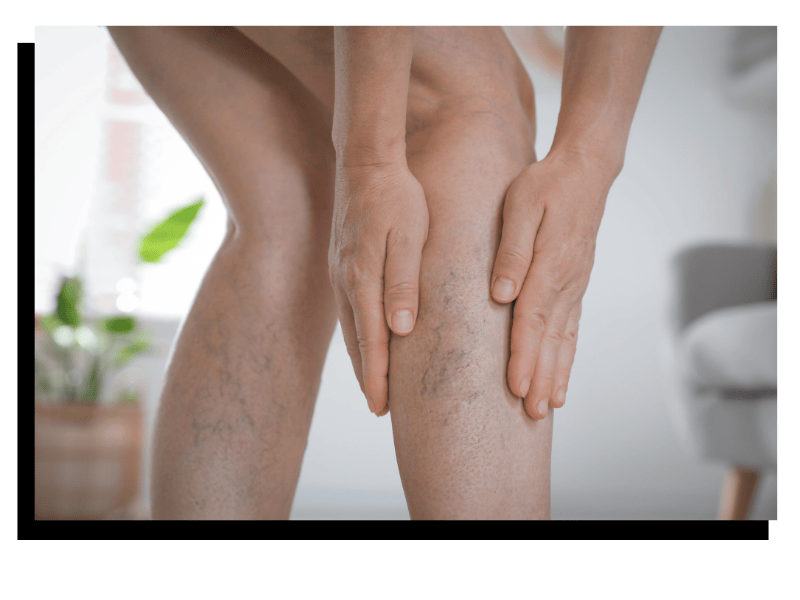
Superficial veins are located just under the surface of the skin. The great and small saphenous veins are the main superficial leg veins.
The great saphenous runs down the inner thigh and leg. The small saphenous begins behind the knee and runs down the back of calf. Both of these veins branch out into a huge network of smaller superficial veins.
In healthy veins, blood flows from superficial veins and their branches through perforator veins and on to deep veins. When valves in superficial veins don’t work properly, varicose veins develop. These can be treated with radiofrequency ablation (RFA) and phlebectomy. The problem superficial vein is closed and other healthy veins take over.
Deep Veins
Deep veins lie deep within the leg, surrounded by muscle. They carry most of the blood out of the legs and back to the heart. Deep veins are not visible and are connected to the superficial veins by perforator veins.
Because these veins handle such a high volume of blood flow, problems like deep vein thrombosis (DVT) can become serious quickly. DVT is a condition where a blood clot forms in one of the deep veins—typically in the thigh or lower leg—and can lead to swelling, pain, or more serious complications if the clot travels to the lungs (pulmonary embolism). While deep vein issues are less common than surface-level problems like varicose veins, they require prompt medical attention when symptoms appear.

Perforating Veins
Perforating veins — or perforators — carry blood from the superficial veins to the deep veins. When the valves of perforator veins don’t work properly, blood is pushed back into the superficial veins. This worsens existing varicose veins and can lead to skin changes and the development of venous ulcers.
Perforating veins can be treated with endovenous laser treatment (EVLA). The problematic vein is sealed shut and other healthy veins take over.
While problems with superficial veins are visible to the eye, there could be much more going on that you cannot see. With ultrasound imaging, Dr. Bellamah can view the entire network of diseased veins. Finding the deeper source of visible varicose veins is important for developing an effective treatment plan.